


000

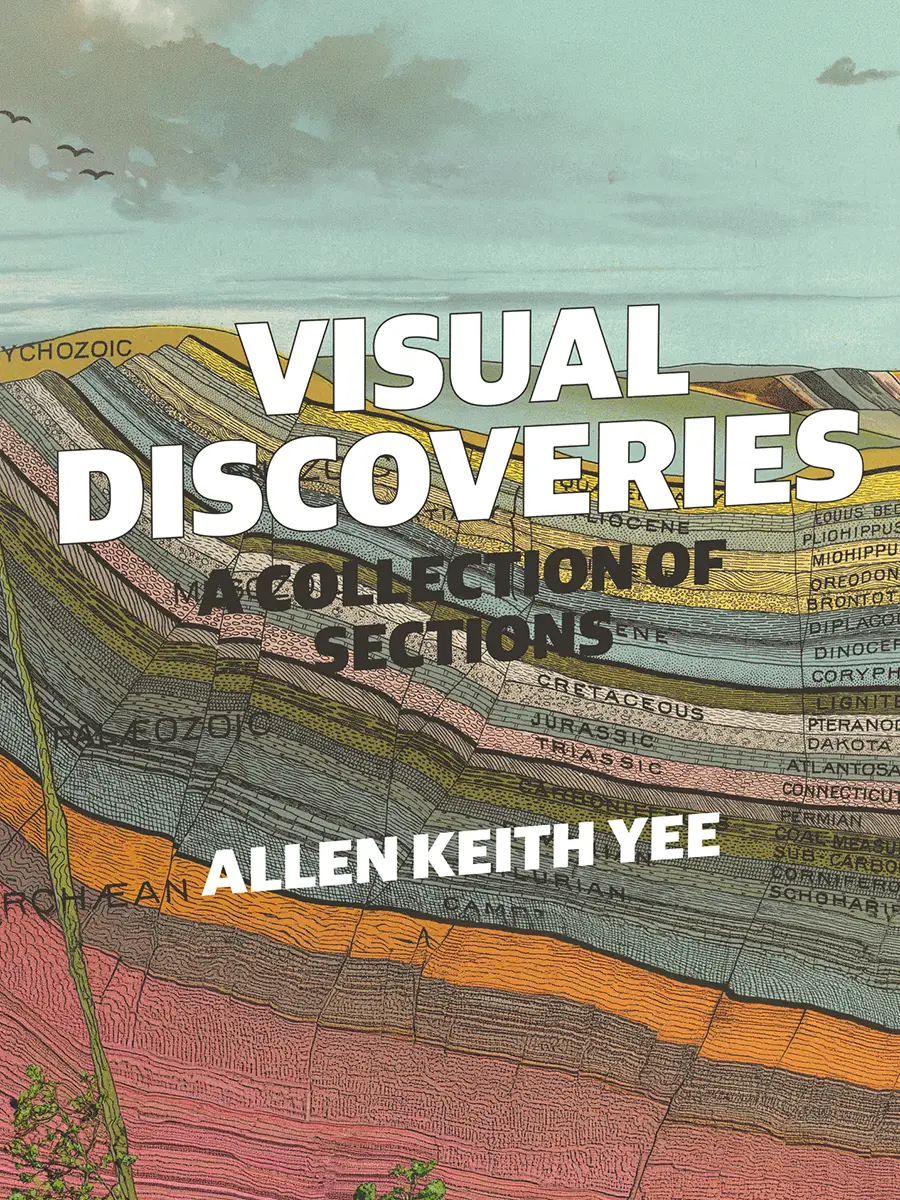
Visual Discoveries: A Collection of Sections
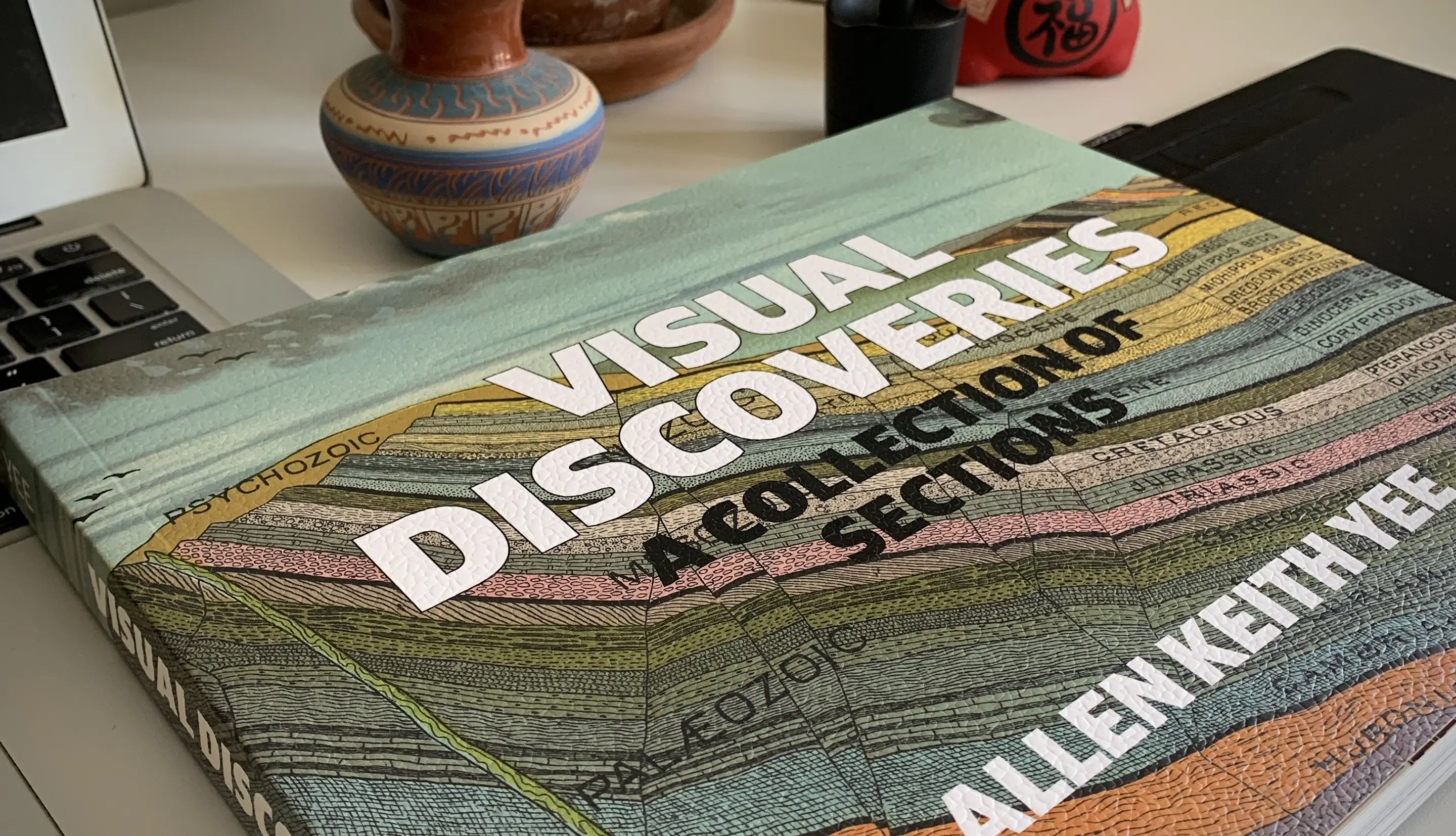
By Allen Yee

Visual Discoveries: A Collection of Sections, by Allen Yee — book image

An image-forward book celebrating the section drawing as a powerful way to reveal the inner workings of buildings, landscapes, cities, objects, natural systems, and the human body.

The book brings together remarkable sectional drawings from architecture, landscape architecture, urban design, geology, product design, and anatomy, including work by Paul Rudolph, OMA, Zaha Hadid Architects, Diller Scofidio + Renfro, Renzo Piano Building Workshop, Foster + Partners, Weiss/Manfredi, and Mecanoo, alongside historic examples by Leonardo da Vinci, Charles Darwin, and Robert Fulton.

The project set out to elevate the section beyond its role as a technical construction document. Unlike plans or elevations, a section cuts vertically through a subject, exposing relationships between inside and outside, structure and space, surface and depth. The goal was to show how this drawing type can be both analytical and expressive, offering unexpected insight into architecture, landscapes, objects, and natural forms.

What began as Allen’s personal archive of notable cross sections grew into a richly researched collection of drawings, stories, and design lessons. The finished book presents the section as a lens for understanding how things are made, how they function, and how they can be imagined.
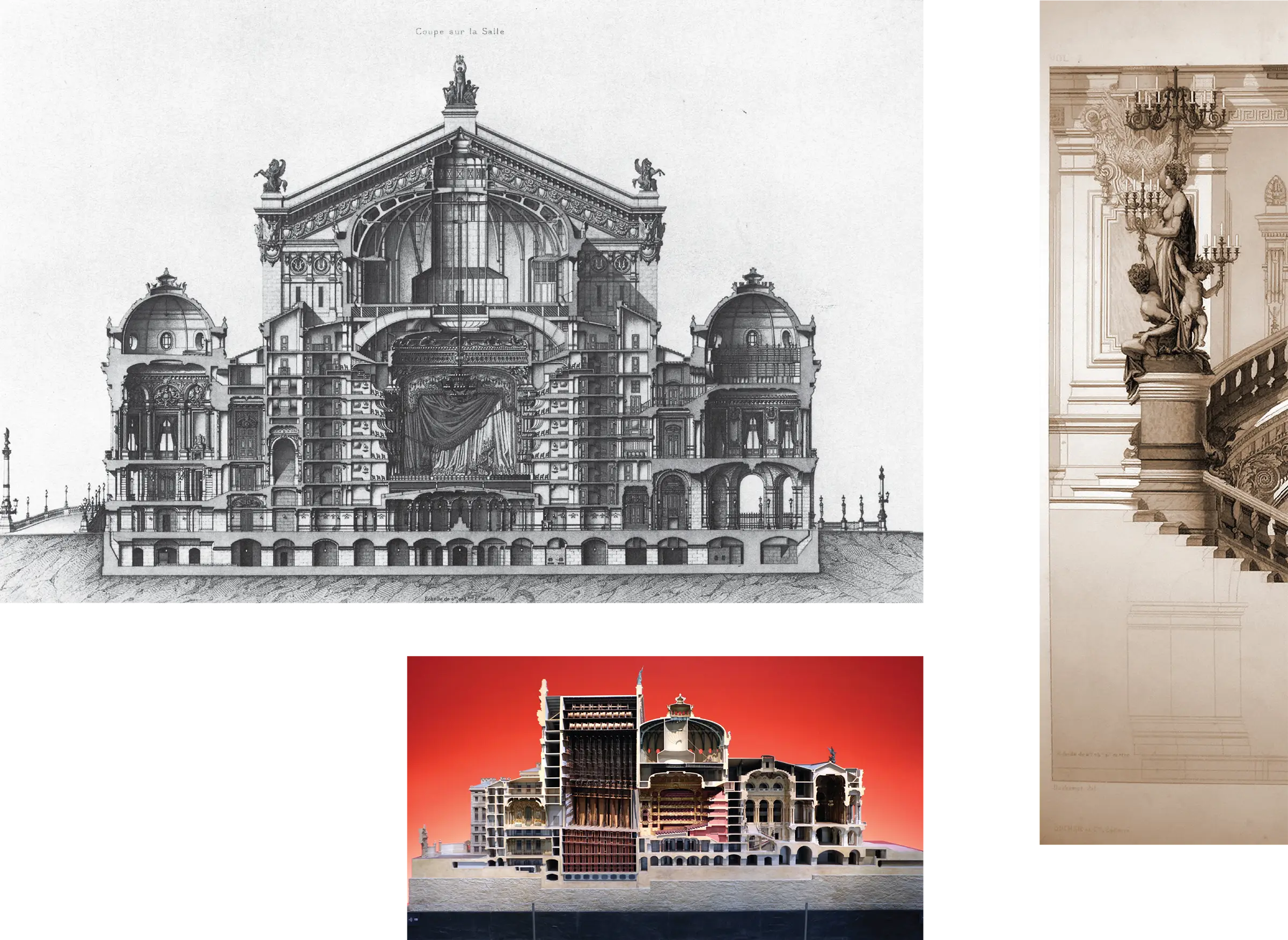
Composite image showing architectural studies of the Palais Garnier in Paris, designed by Charles Garnier for the new Paris Opera. A large black-and-white transverse section drawing reveals the auditorium, stage, roof structure, side pavilions, corridors, and layered interior rooms in intricate detail. Below it, a color model shows the same sectional view against a red background, emphasizing the building’s complex stacked volumes. At right, a narrow sepia-toned drawing focuses on the grand interior stair, with sculptural figures, ornate railings, chandeliers, and classical decorative details.
Transverse Section at the Auditorium and Pavilions, Palais Garnier. Paris, France 1880. Charles Garnier designed the “Le Nouvel Opéra de Paris,” ommonly known as “Palais Garnier,” for a two-stage competition.
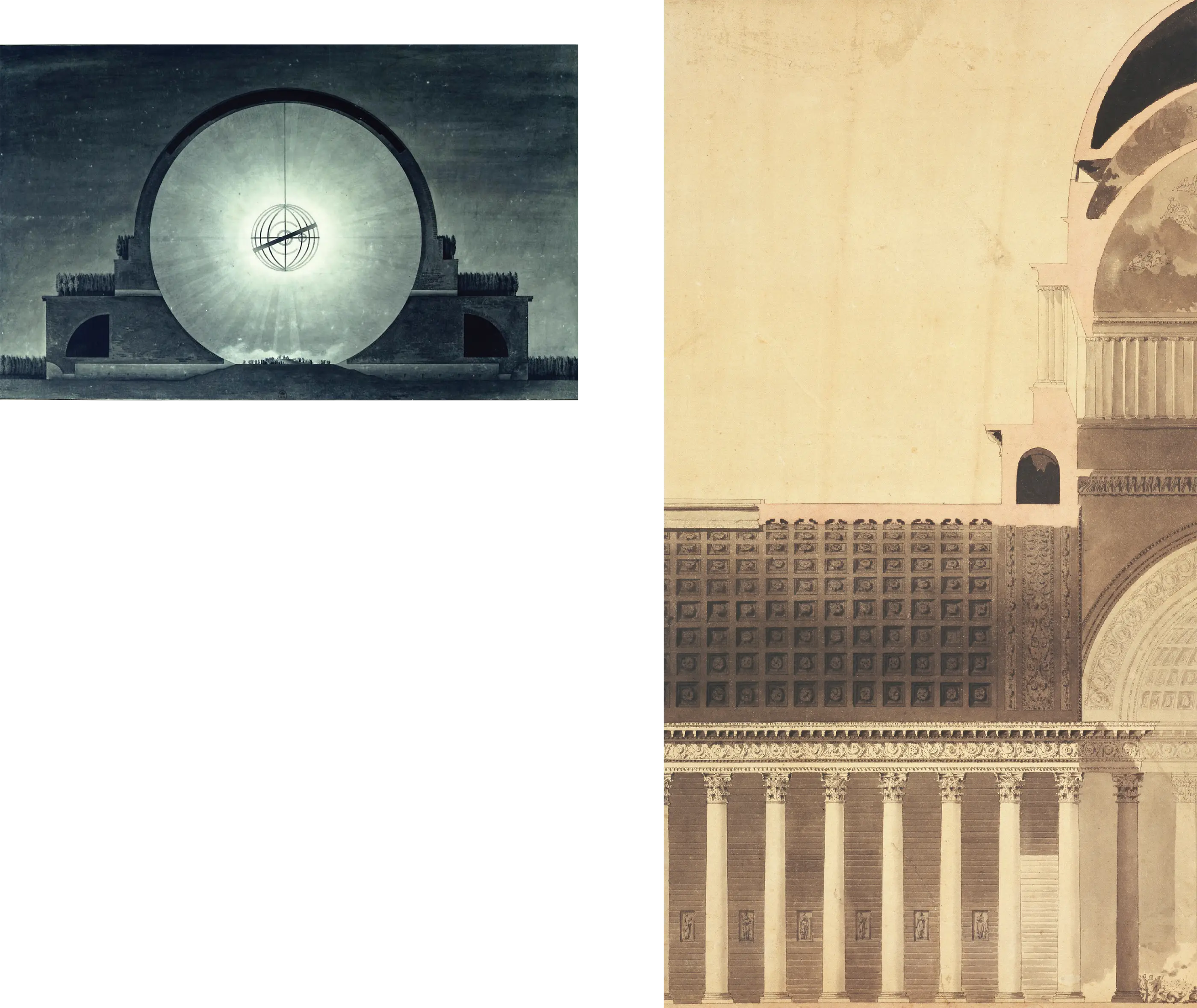
Two architectural drawings attributed to Étienne-Louis Boullée show a monumental neoclassical design for the Church of the Madeleine, dominated by abstract geometric forms. On the left, a dark elevation features a glowing central sphere set within a massive arch, with a small armillary sphere-like element at its center. On the right, a pale section drawing reveals a vast domed and colonnaded interior, emphasizing the project’s immense scale and its fusion of classical architecture with visionary geometric abstraction.
Architectural Project for the Church of the Madeleine by Étienne-Louis Boullée. Boullée’s cenotaph is neoclassical with abstract geometric forms aking up the design. The main part of the building is a sphere that would be 500 feet tall, topping the 455-foot pyramids of Giza.
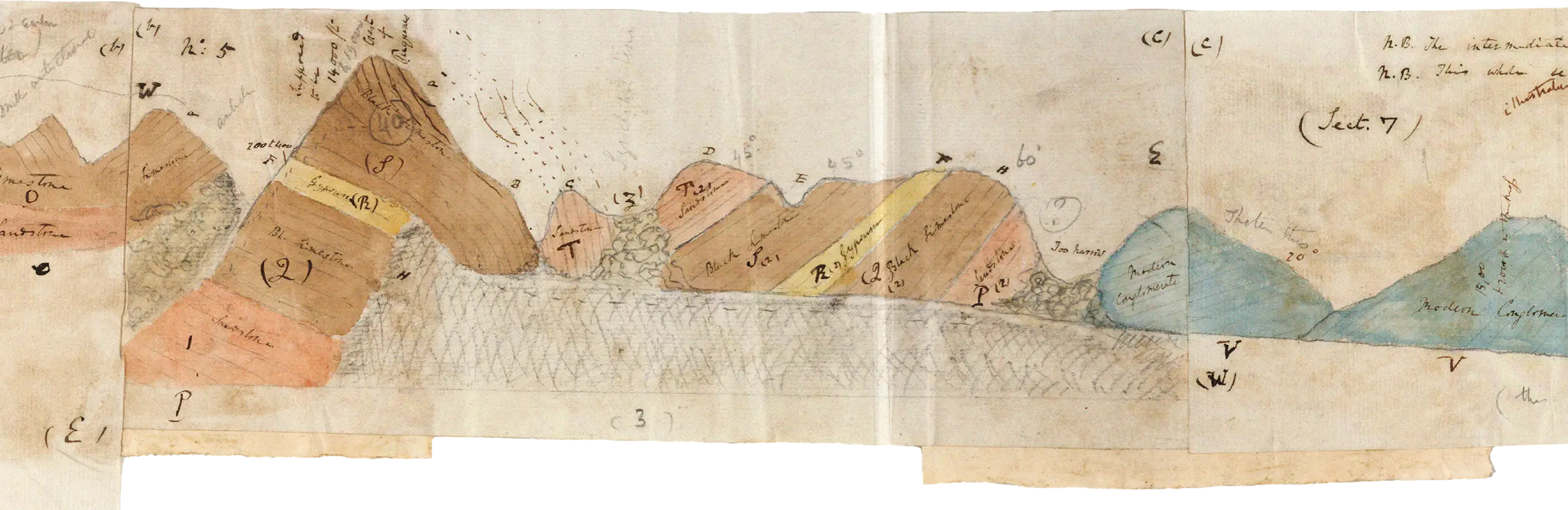
Hand-drawn ink and watercolor geological cross section by Charles Darwin, showing a stratigraphic section through what is now Chile. The long, folded paper diagram uses muted brown, blue, yellow, orange, and gray washes to distinguish different rock layers and formations. Sloped hills, faulted strata, rubble zones, and labeled sections are annotated with handwritten notes, compass directions, angles, and lettered markers, revealing Darwin’s close observation of geological structure and terrain.
Though he is best known for his theory of evolution, Charles Robert Darwin (1809–1882), was also a respected geologist. In this ink and watercolor, hand-drawn cross section, Darwin depicts a stratigraphic section through what is now Chile.
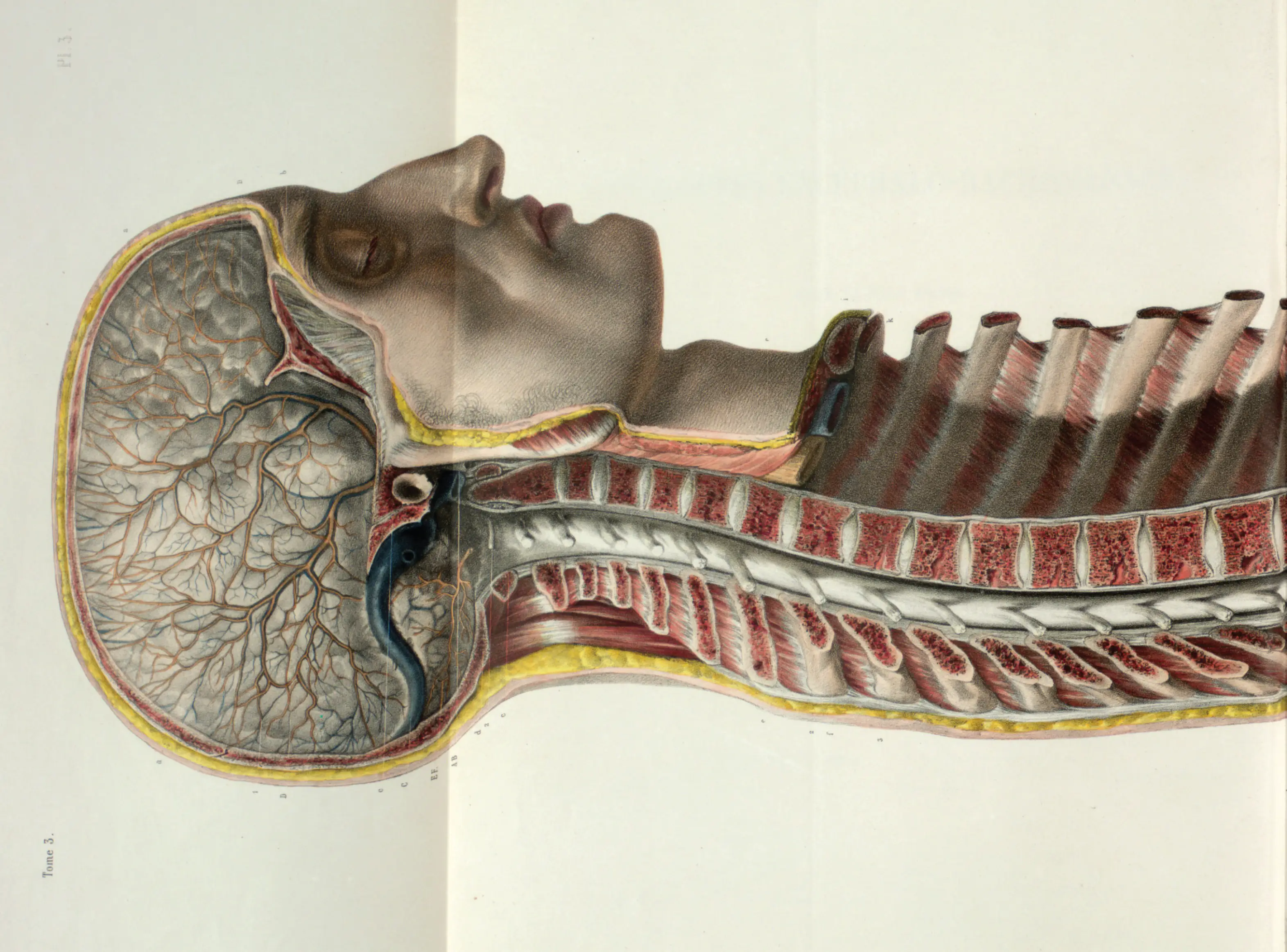
Color anatomical illustration from Jean-Baptiste Marc Bourgery and Nicolas Henri Jacob’s Traité complet de l’anatomie de l’homme, showing a side view cross section of a human head, neck, and upper torso. The skull is opened to reveal the brain’s surface, blood vessels, and surrounding tissues, while the neck and spine expose vertebrae, muscles, fat, airway structures, and internal passages. The figure’s face is rendered in profile with painterly shading, contrasting with the precise, layered anatomical detail of the dissected interior.
Jean-Baptiste Marc Bourgery (1797–1849), a French physician and natomist worked with Nicolas Henri Jacob (1782–1871), a painter and llustrator n an ambitious twenty-year book project. Completed in 1854, Traité complet de ’anatomie de l’homme “Complete Treatise on the Human Anatomy” is a visual masterpiece of anatomy with over 700 illustrated plates, many in color.

“A lushly visual book.”

AIA New York, Center for Architecture

More Projects